

Buying real estate is a dream that many Kenyans hold. And there are good reasons why this is the case including; real estate’s stability and being an asset you can touch and control. However, many buyers often make a big mistake when buying property by getting the timing wrong. We have all heard of the number one rule of real estate which is Location, but few people talk about timing the market.
One thing that you need to understand is that the real estate market is always moving in cycles. At one time prices are high, then the next minute they come down and this is not unique to real estate but all markets. For you to make money, you basically need to buy at low prices and wait for when the market cycles up before selling at a higher price and pocketing the difference which is your profit. In this guide, I will be giving you a breakdown of the best time to enter the Nairobi real estate market as well as questions you need to answer before deciding to buy.
Questions to answer before you buy
Real estate marketers will always sell you the FOMO of not buying a property and this makes it look as though anytime is the best time to buy. However, before asking clients to commit their hard earned money to a project, I like establishing their goals and intent. Answering the questions below will give you the clarity you need before deciding on which property you want to buy.
1. How much are you willing to spend?
The first question you want to answer is, how much are you looking to spend. This assesses your budget and helps you narrow down the locations you can find a house in. For instance, if your budget is KES. 4,000,000 there are some places you shouldn’t even bother looking.
2. what is the type of unit you want?
Next is the typology of house you want to buy. This could be either a studio, 1-bedroom, 2-bedroom or 3-bedroom. With a clear budget and the correct typology, you will easily find a suitable unit and avoid being swayed in the wrong direction by people who just want your money. It also gives you the discipline to be able to wait for the right time to buy if what you are looking for is not available at the moment.
3. Why are you buying?
Another critical question is WHY are you buying. Truth be told, I have met a lot of buyers who are just being pushed by their peer groups to buy property. Two good reasons that standout to me have always been;
- Buying a home to live in
- Buying a house as an investment
Knowing your WHY will help you know exactly what you should focus on in a property. If you want a home to live in and escape rent, then yields might not be as important. Your focus should be on the quality of life you get from the property with features such as gyms, a swimming pool or a community center. A person buying the property as an investment will look at yields and returns.
4. Personal Preferences
Another important factor circles around your personal preferences as a person. I have met buyers who wanted a development with a good sense of community because they needed children to play with their kids. You may want a place near a good school to avoid waking your child up at ungodly hours.
The Property Cycle in Nairobi
Real estate like any other market is governed by supply and demand. Currently in 2026 at the time of writing this guide, we are in a buyer’s market. This means that as a person looking to buy, you have the upper hand in terms of negotiating property prices. Understanding the property cycle will help you know when to get in and when to sit out.
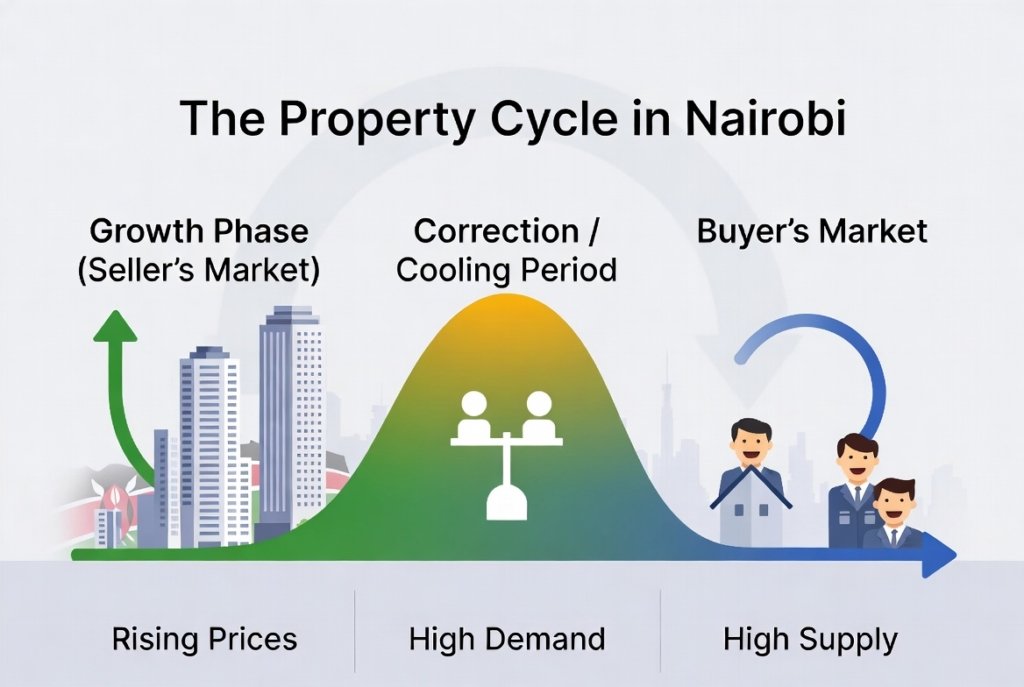
1. Growth Phase (Seller's Market)
The growth phase occurs when people discover an area. Currently places like Kabete where developers are beginning to flock exemplify this phase. Prices in these places rapidly rise because demand is greater than supply. In this phase, buyer hype and sentimentalism are often marketed together with property. In most cases, the sale prices of most properties might not reflect their true values.
2. Correction/Cooling Period
In this phase, supply and demand are nearing an equilibrium which means there is an almost an equal number of buyers and sellers. Prices often come down to bring valuations within market fundamentals. The cooling period reveals what properties are actually worth as buyers are able to negotiate a bit more confidently.
3. Buyer's Market
During this phase, more properties are available than buyer and they are often at lower prices. Sellers have to come up with creative ways to make their units sell and if you are a buyer, you have more negotiating power. Places like Kilimani that have experienced a construction boom are seeing this phase.
Best Time To Buy Property in Nairobi
1. When CBK interest rates are low
When the CBK lowers interest rates, the cost of financing using mortgages goes down. As a buyer, you are likely to get cheaper loans and this makes it a good time to buy. Another effect of lowered rates is that they push institutional investors and banks towards real estate and as a result, the supply of units goes up.
2. Nearing Election Periods
In Kenya, the period leading towards an election is often marked by a lot of speculation. Most investors adopt a “Wait-and-see” approach before deciding to commit more capital. In the past, post-election turmoil has often led to destruction of property and a slowed down business environment. If you are a risk-taker, most developers are always looking to dispose of the units and you can grab one at a fairly discounted price.
However, if the project has not yet been started, you might want to sit-back and wait for the election period to end. In the event that things get shaky in the country, project timelines will be affected and prices will vary which risks the completion of the project you bought into. Moreover, your developer may use the “Force Majeure” clause if things go bad and you may end up losing all your money.
3. During Project Launches
When a project is at ground breaking level, the risk is often higher and developers will sell off-plan units at a discount to attract buyers. If you get in at this early stage, prices are usually low and they present the best times to buy into a development. I have seen people buy units for KES 4,000,000 and when the project gets completed, they sell the same unit to other buyers for KES 6,000,000.
Caveat: If you chose to buy at the start of a project, make sure you have done your due diligence on the developer to make sure they can finish the project.
4. Mid-Year
In Nairobi the market is often much slower during the mid-year period of (May – July). In this period most buyers are sorting out other responsibilities like school-fees and other expenses. This makes it much easier to negotiate prices as fewer buyers are available.
5. Last-Quarter
During the (October – November) period, developers are looking to close their books and many are desperate to meet sales targets. They will often ask their sales teams to call anyone who might have shown interest in the property and give them a new offer. In such a period, you will be able to bargain and get good prices for the unit.
6. In economic downturns
There is a quote by Warren Buffet that says “Buy when the market is selling and sell when the market is buying.” During periods of economic downturns, most people are in panic and looking to sell, if you are willing to take a risk, you will get some of the best deals out here. Another good strategy that marries well with this point is targeting ‘For closure’ properties. Owners often sell their properties in times of economic downturns and in most cases they tend to accept below the market prices.
If you are looking to buy property but dont know where to start, send us your preferences and we’ll shortlist properties that meet your criteria.